
Spotlights
Brian Gregory
A spotlight conversation with the filmmaker behind Daniel Came Home.
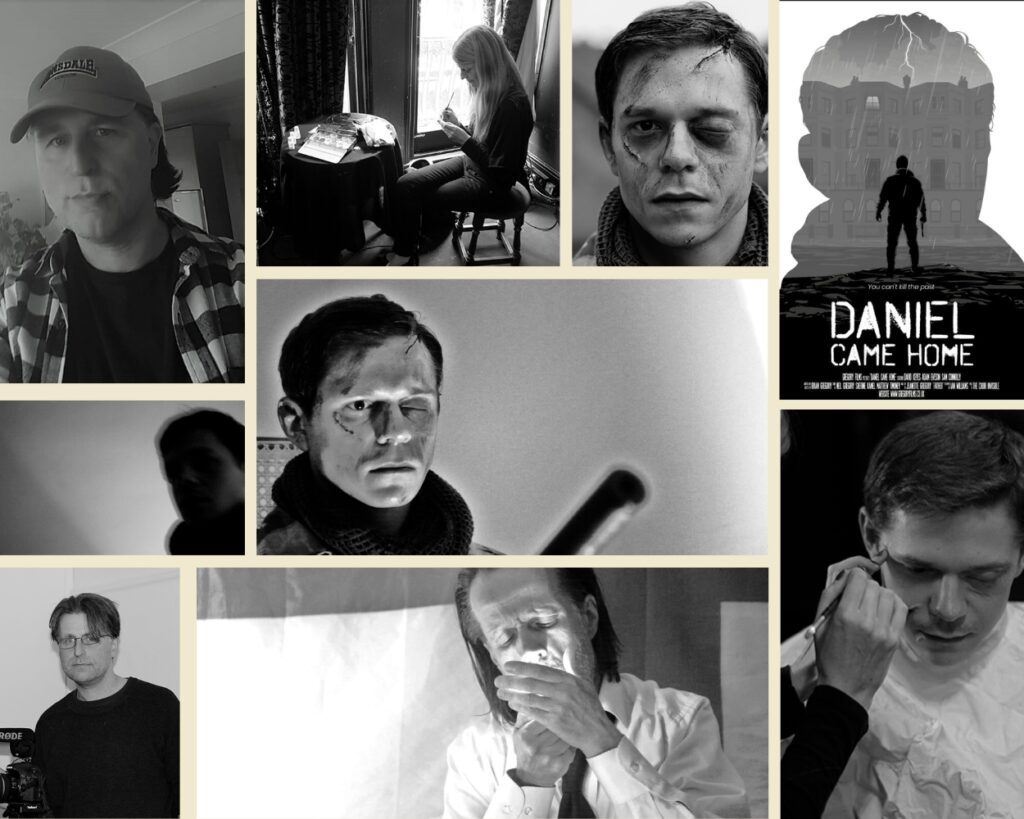
Spotlight Interview
Brian Gregory
Filmmaker · Daniel Came Home
A musician and film-maker from London, now living in Hove, Brian Gregory also works as an English tutor and writes for several horror film publications. His short Daniel Came Home began as a short story published in The Fifth BHF Book of Horror Stories.
Hello, could you please tell us a little bit more about your submitted project? How did you come up with such an original story?
‘Daniel Came Home’ was originally a short story I wrote, named ‘Daniel’. This ended up being published in a horror anthology: The Fifth BHF Book of Horror Stories, but I had always intended to make a short film of it with two actors in one setting. The idea was initially inspired by Bob Clarke’s ‘Dead of Night’ (1974) and the films of Alan Clarke. Other inspirations were a particularly unpleasant father of a friend of mine, my own father’s army experiences, childhood football memories, disgust at the Invasion of Iraq and Afghanistan, along with the lasting effect of my father’s experiences from the armed forces, such as nuclear tests and indoctrination on both myself and my family. It’s quite a personal film and there is definitely some of myself in the character of Daniel.
Tell us something about yourself and your background. Do you remember the first movie you watched? Were you enthralled?
I’m a musician and film-maker from London, now living in Hove. I also work as an English tutor and write for several horror film publications. The first movie I remember watching was The Jungle Book (animated Disney version) on television. I loved escaping into another world, plus the songs were irresistable! At the cinema, it was probably a Bond film. Again, I loved being taken away from my boring suburban life into an exciting fictional world. I was fascinated by the cinema and the ritual of lights dimming, the hushed anticipation and finally, the film appearing on a huge screen in front of me.
Who are the directors that inspire you? What would be your favourite movie?
The directors who inspire me would include: Alan Clarke, Stanley Kubrick, Agnes Varda, David Cronenberg, Luis Buñuel, Sidney Lumet and Orson Welles. At gun point, my favourite film would be either 2001 or An American Werewolf in London.
Was there a particular time when you recognized that filmmaking is your way of telling stories?
I found that filmmaking is a very good way for me to express feelings, thoughts and experiences from my life and my imagination. It’s a healthy, enjoyable creative process. Story-telling via this medium is a great way of connecting with people and commenting on life. Previously, I had made music in a band, for television and for other people’s films, but when the cost of making indie films came down, I dipped my toe in those waters.
What are some of the biggest challenges you encountered in making this film?
Some of the biggest challenges filming Daniel Came Home were the lack of budget (although that helped creativity) and getting the two main actors together on the same day, as we filmed their scenes many miles from where they live. We ended up having them together for only a few hours. The crew was tiny: myself and alternating sound guys, plus my sister (who did the make-up) and two actors. Like most filmmakers, it’s always a challenge to find time around a full-time job for filming and editing. But this is a passion of mine.
What were the production realities from casting through editing that you had to accommodate?
I was keen to work with David Keyes, as I had admired him in many shorts, on TV and even in Hollywood movies, knew that he lived near Brighton and could see that he’d be perfect to play Jack. I had heard that he liked my previous short, ‘Janet Devis’, so I plucked up the courage to send him the script and luckily, he liked it. Adam (Daniel) is a stage actor and after seeing one of his shorts, I knew he’d be perfect as Daniel. Rehearsals showed that the two had chemistry and empathy for each other. With little financial resources, I placed an emphasis on atmosphere and short bursts of dialogue, feeling that the story would work best in stark black and white, with a lot of time spent on sound FX and music choices. My sister is a trained film make-up artist, who has worked on various projects, and she took care of the make up and costumes. I hired another Gregory (no relation-Neil) to score the film with my suggestions. I’d created music with him many times before. Several people took turns as sound recordists. In post, I added many home made sound FX and ended up shooting a fair bit more footage without the actors. This film spent quite a while in post. I went through two abandoned edits before settling on the finished piece. The first attempt had far too much dialogue and wasn’t gelling, it had no rhythm. The second attempt involved still images with narration, combined with sudden pieces of moving image. A nice idea but, again, it didn’t quite gel. I then took ideas from each version, shot quite a few inserts last year to add to the mix and created the finished film (though the fever dream sequences with Daniel remained pretty much the same).
What are the audience reviews of your project?
Audience reviews have been very positive and we were recently selected for a screening of new short-films at ActOne in London, an indie cinema, so we watched on a full-sized screen with a packed audience and were delighted at the reaction.
Do you believe that a filmmaker should bring always something original or he/she should stick to classic but cinema styles?
You are the sum of your influences, but must put your own stamp on your work and hope that it will register with audiences. With new, more affordable technology, it’s important to experiment, create and attempt new directions in film-making, while respecting the classics.
In Their Words
“You are the sum of your influences, but must put your own stamp on your work and hope that it will register with audiences.”
Brian Gregory
Do you think that film festivals are playing an important role in filmmaking industry? Why are they necessary? How do you get the most out of them?
Festivals remain important for feedback and networking. Plus, the sheer enjoyment of watching lots of films over a day/several days and listening to other film-makers. They can also be a source of inspiration.
What are your future plans in your filmmaking career?
I have almost finished shooting my first horror feature named ‘Witch’ (Brighton and Isle of Wight shoots-currently doing some reshoots). It’s a micro-budgeter shot, directed by myself. I’m very pleased with it and hope that ‘Daniel Came Home’ may act as a calling card, impress distributors, actors, film fans, etc and gather some interest in the feature. After that, I’d like to make an idea that I have in mind, but with a bit more of a budget!
Curtain Call
More Voices From the Spotlight
Meet the other filmmakers of this season, then bring your own story to Barcelona.