The Choice
Directed by Stephen Barnett
Synopsis
Inspired by a true story:
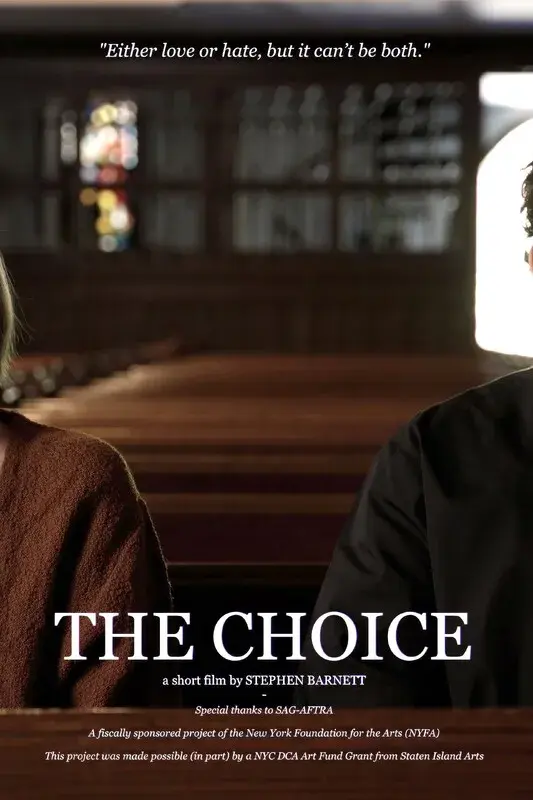
THE CHOICE is a short film about Tracy and tells the story of their Grandmother, Mrs. “Ruth” Wilson, who is trapped between loving the sinner and hating the sin so she turns to her Priest for guidance.
Director Biography
Stephen Barnett is a Queer Filmmaker.
THE CHOICE is their 21st short film after 20+ years of exploratory no-budget projects of varied length and a few accolades while earning a CUNY Baccalaureate in Theatre & Cinema and a Master’s in Gender, Sexuality, and Cinema Theory. They spent ’22 producing this short film project to socially empower their mother’s choice while mourning the passing of both parents in the Fall of ’21. They just accepted the offer of admittance for the Fall ’24 semester to the Media Producing MA program at Tisch School of the Arts, New York University.
Director Statement
What compels a person to choose a contrary point of view to the only one they’ve ever known? For Mrs. “Ruth” Wilson (Lucy McMichael) it is the tragic consequence of the inherent trap of both loving and hating, which prompts the discussion with her Priest/Father (Alessandro Colla) regarding the main/principal character Tracy (Ruth’s LGBTQ+ grandchild). When writing the script and then working with Lucy, Alessandro, and the collective Crew the mis-en-scene’s objective was Ruth’s communicating from an evolving clarity of self-awareness.
Like an isosceles triangle, the story has three central characters. As the triangular base, Ruth propels the plot while growing and changing along the way and the Priest stalls the plot by reverting to his ingrained historical faith in congruent opposition. Both characters sit beside one another in a church pew facing forward toward the altar with just over a couple of feet between their centers, which literalizes the gap between their perspectives but also exposes the depth-of-breath apex behind them for the audience. Accordingly, the third central character is the apex LGBTQ+ grandchild Tracy; a purposed gender-neutral name. As the film’s main/principal character, Tracy is the reason for the story, the point of the discussion, and the impact of the plot’s conflict. Although Tracy doesn’t actually ever appear they render comparable to Claude Debussy’s writing about how music is not in the notes but in the spaces between them. Tracy is unseen but ever-present and heard within the depth of space between/behind Ruth and the Priest. Further still, Tracy’s unseen personhood acts as the universal/collective LGBTQ+ surrogate for the audience precisely because they are unseen.
On the one hand, seeking examples from film history where the main/principal character is never seen provided several distinct films: A Letter to Three Wives (Addie), Gaslight (Alice), Harvey (Harvey), and Laura (Diane). On the other hand, finding points of reference involving characters sitting and having a real-time conversation was relatively difficult, but not impossible. Influences were drawn from Ingmar Bergman’s, Scenes from a Marriage (1974) but more specifically from Louis Malle’s, My Dinner with Andre (1981). Nevertheless, Grant Wood’s painting, American Gothic (1930), served as the primary visual inspiration and the experience of sitting in a Catholic church being lectured to week after week like an echo chamber throughout my childhood was the inspiration for the resonate affect of their discussion, which was natural to the filmming location and not an added post-production effect.
My intent was to reverberate the tone, mood, and energy of dialog against the visually historic architecture of the Gothic Revival church while keeping them trapped, tense, and confined together as if claustrophobic within the coffin-like frame delineated by the 1:85 aspect ratio. The church interior’s earth tones illuminated by stained glass windows, sconces, and chandeliers lent a soft sepia-like visual atmosphere reflecting the historical nature of religion. The open entry/exit doors in the background provided the bright light of salvation accompanied by the auditory sounds of life out in the world. I wanted the cinematography to primarily move through time and space as if Audience-as-God. Utilizing the simplicity of a tripod and exploiting the 180 degree and its 20 & 30 degree rules for the film’s cinematic sequence focuses the story’s discussion. At times and almost unnoticeably, each seemingly stationary new framing methodically creeps back and forth as a subtle aggressive and digressive means of pushing and pulling at the tension of their transgressive dialog. The characters’ exchange of power is mirrored by shifting focal points. The opening singular shot down on Ruth’s face is as sharp as a 4K tack but then she blinks and now she’s slightly bleary in confusion. The Priest interrupts her, uses her vulnerability against her, and reminds her of her place. Ruth’s uncertainty remains until just as she opens up about her inner-conflict and narrative/monologue. Consequently, when she confronts the Priest with the written words of his belief system it is now he who is left fuzzy in confusion.