
Spotlights
Espen Jan Folmo and Nini Caroline Skarpaas Myhrvold
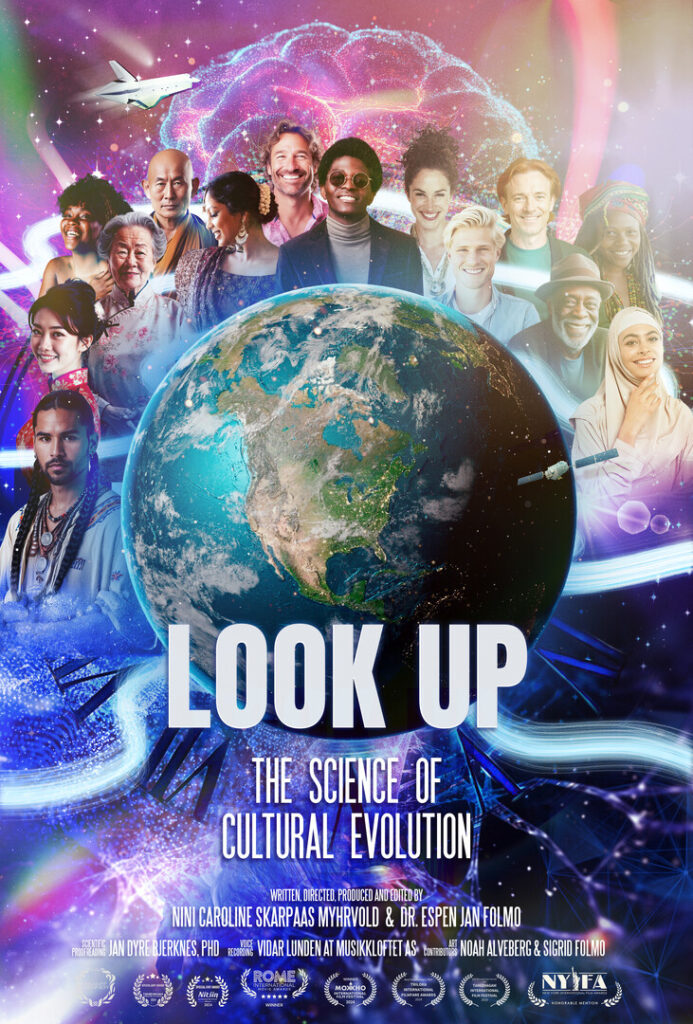
The co-directors of LOOK UP - The Science of Cultural Evolution on scientific poetry, constructive friction and the film of their lifetimes.
Spotlight Interview
Espen Jan Folmo and Nini Caroline Skarpaas Myhrvold
Co-directors · LOOK UP—The Science of Cultural Evolution
Nini’s roots are in psychology and writing, exploring human spirituality through science, while Espen’s background spans economics, cross-cultural research, and psychology. Their feature-length documentary LOOK UP bridges science and spirituality in an ambitious exploration of humanity’s collective journey.
Hello, could you please tell us a little bit more about your submitted project? How did you come up with such an original story?
LOOK UP—The Science of Cultural Evolution is a feature-length documentary that bridges science and spirituality in an ambitious exploration of humanity’s collective journey. At its heart, LOOK UP tells the greatest story ever told – the story of humanity’s search to merge into something greater than itself. We set out to illuminate the hidden threads connecting psychology, philosophy, and culture, weaving years of research with poetic cinematic storytelling. The film spans questions of human evolution, consciousness, and cooperation across time. In tone and structure, it’s as much a philosophical essay as it is a visual journey – a “time-sculpture,” to borrow Tarkovsky’s metaphor for film. We wanted LOOK UP to feel timeless, a piece as relevant to our grandchildren’s generation as to our own, inviting viewers to step back and see our cultural ecosystem from a new vantage.
The story’s originality stems from the deeply personal wellspring of our combined experiences. In truth, this film feels like the project of our lifetimes. Its inspiration came from virtually everything we have lived and learned – from playing Bach’s fugues to delving into psychological theories and spiritual practices. Over years of late-night conversations, we realized we were gathering pieces of a puzzle that no existing film had quite put together. If we are completely honest, our motivation was simple: we wanted to make the kind of film we ourselves yearned to see. We saw a gap – a film that did not yet exist, one that could present the most important insights we’ve encountered in a structured, immersive, and transformational way. And so LOOK UP became that film. It’s an original story in the sense that it synthesizes countless influences into something new. Like Shakespeare weaving old Renaissance tales into a unique creation, we’ve sought not to imitate but to synthesize – layering scientific depth, cultural wisdom, and artistic vision into a narrative that is uniquely ours. The process of creating this film was one of discovery; often it felt less like we were inventing a story than uncovering one that was waiting to be told.
Tell us something about yourself and your background. Do you remember the first movie you watched? Were you enthralled?
We come from backgrounds that, on the surface, are far from the film world. Nini’s roots are in psychology and writing, exploring human spirituality through science, while Espen’s background spans economics, cross-cultural research, and psychology. In other words, we’ve worn many hats – therapist, researcher, musician, publisher – before donning the filmmaker’s cap. This unlikely mix turned out to be a strength: our work in academia and healing arts gave us a deep well of ideas and a sense of purpose beyond entertainment. Storytelling was always in our blood, but it often took the form of academic papers, lectures, or music compositions. When we finally turned to cinema, it felt like coming home, because film allowed us to blend all those disciplines into one cohesive art form. We like to say our film is “scientific poetry” – a phrase that reflects how our analytic and creative halves unite on screen.
As for the first movie we ever watched, it’s hard to pinpoint – memory is a kind editor, often splicing together our earliest cinema experiences. What we do remember is the feeling of enchantment. We both grew up immersed in art cinema, the kind of films that linger in the mind and ask big questions. One of us recalls being mesmerized by the vivid imagination of The NeverEnding Story as a child; the other was transfixed by the mystical quiet of an Andrei Tarkovsky film in their youth. In those moments, yes, we were absolutely enthralled – not just entertained, but transported. That wide-eyed wonder we felt in the dark of the theater or the glow of the TV screen never really left us. It set the cornerstone for our creative lives. Even now, as directors, we chase that feeling of awe. We carry into our work the same openness and curiosity we had as children staring up at the silver screen. In a sense, every movie we make is an attempt to re-create that magic and share it with others.
Who are the directors that inspire you? What would be your favourite movie?
Our inspirations span a broad spectrum, but we’re especially drawn to filmmakers who infuse their work with philosophical depth. Visionaries like Andrei Tarkovsky, Stanley Kubrick, and Alejandro Jodorowsky inspire us for their willingness to break the mold and challenge conventional storytelling. Each of them created a language of film uniquely their own – Tarkovsky with his meditative, spiritual realism; Kubrick with his meticulous, probing gaze into human nature; Jodorowsky with his surreal symbolism and bold imagination. We learned from them that cinema can be art and inquiry at once, entertaining the senses while also nourishing the soul.
It’s difficult to choose a single favourite film, as different movies have guided us at different times. If we may, we’ll mention a few that resonate profoundly with us. The Matrix is one we often cite – it might be dressed as science fiction, but at its core The Matrix feels like a “psychological documentary” about the nature of perception and reality, which speaks to our fascination with consciousness. We’re also deeply moved by Groundhog Day – beneath its comedic premise lies a story of spiritual transformation and self-discovery that mirrors the kind of transformative journey central to LOOK UP. And we have to mention The Mission, a film we both hold dear for its harmonious blend of music, philosophy, and the human spirit. Each of these films, in its own way, has shown us how powerful cinema can be when it marries emotional engagement with big ideas. They remind us that a movie can entertain and enlighten simultaneously. We hope LOOK UP follows in that tradition – engaging the audience on a visceral level while also inspiring reflection on deeper truths.
Was there a particular time when you recognized that filmmaking is your way of telling stories?
Rather than a single epiphany, it was a gradual awakening. We’ve always been storytellers at heart – in fact, we first expressed it through music, writing, and teaching – but over time we realized that film is the most holistic language for what we want to say. There was a moment, or rather a phase, when this recognition crystallized. We remember sitting together, discussing an insight from psychology and a poem by Rilke in the same breath, and imagining how we might convey that fusion of science and poetry. We looked at each other and understood that a film could do it: film could integrate all the building blocks of our lives’ work into one experience. In cinema, we saw a medium vast enough to hold the intellectual nuance of a thesis and the emotional punch of a symphony.
Filmmaking became our way of telling stories when we understood that the screen could be our canvas for complex ideas. A turning point was realizing that an academic paper or a lecture, though informative, couldn’t move an audience the way a film can. Film is a universal language – it lets us communicate complex ideas in a way that resonates with both the heart and mind. We recognized this the first time we tested a small concept on camera: the combination of imagery, music, and narrative created an alchemy we’d never achieved in print. It hooked us. We knew then that if we truly wanted to engage people and spark meaningful conversations, filmmaking was our path. In short, it wasn’t just that we chose film – it’s that film called out to us, offering a rich soil where all our diverse interests could take root together. Once we answered that call, there was no turning back. We had found our voice in the glow of the projector.
What are some of the biggest challenges you encountered in making this film?
Creating LOOK UP was a monumental undertaking, and it tested us in every way imaginable. One of the earliest challenges was distilling our vision into a workable form. We had what felt like an infinite universe of ideas – decades of insights from psychology, philosophy, history, personal experience – and the question was how to funnel that into a coherent film. The filmmaking process is like forcing ideas through a bottleneck: resources are limited, time is limited, and we had to make razor-sharp choices so that each scene would serve the overarching purpose. This meant letting go of some ideas we loved. “Kill your darlings” became an everyday mantra.
Another major challenge was the dynamic of collaboration itself. As co-directors, we often had different perspectives on how to convey a concept or structure a sequence. Early on, this could feel like creative tension pulling us in two directions. But instead of compromising in a way that diluted our ideas, we embraced what we call constructive friction. Over time, that friction polished our work into something clearer and more powerful than either of us could have created alone. The film is truly a hybrid of both our minds – a third entity that neither of us could have summoned individually.
Finally, the sheer technical and logistical scale of this project stretched us. LOOK UP runs just shy of three hours and brims with animation, archival footage, and an intricate soundscape. At one point, rendering the final cut took three weeks straight. Our computers groaned, our patience was tested, but our vision never wavered. We faced the usual indie challenges – limited budget, time constraints, scattered teams – but through it all, our commitment to the integrity of the film kept us going. Every obstacle sharpened us.
What were the production realities from casting through editing that you had to accommodate?
LOOK UP is a documentary essay film, so casting in the traditional sense was minimal – we weren’t selecting actors for roles, but rather curating authentic voices and moments. In a way, our “cast” consisted of ideas. We selected interviewees and voiceovers who could personify the insights we explore, and we even used synthetic narration in places to cultivate a certain tone. This presented creative challenges – when you don’t have a conventional protagonist, your structure must work even harder to carry the viewer.
Filming spanned multiple locations and involved collaborators across continents. We worked with a dedicated crew who helped us gather natural and urban imagery from around the world. Limited budget meant we had to be resourceful: borrowed gear, dawn shoots, natural lighting – anything that could capture the vision without compromising quality. Animation was another layer – turning abstract ideas into visual metaphor required a language all its own, and that was invented through constant experimentation.
Editing, though, was the crucible. We had an enormous amount of material and a non-linear narrative. The edit became a sculpting process: shaping rhythm, flow, and clarity out of complexity. Each choice in the edit demanded both rigor and intuition. The goal was not just coherence, but resonance – to craft a structure that would allow people to feel the ideas, not just understand them.
What are the audience reviews of your project?
The reception to LOOK UP has been richly varied, which we take as a good sign. Some have found it overwhelming, even baffling – and we embrace that. It’s a dense, layered film, and not designed for passive viewing. We’ve received some amusing negative feedback (a YouTube comment called it “headache-triggering”), but even criticism tells us that the film left a mark.
On the other side, we’ve had the privilege of hearing from viewers who called the film “life-changing,” “mind-opening,” or “the most meaningful documentary I’ve ever seen.” We’ve received awards across international festivals, and the praise often mentions the film’s unusual depth and originality. That range of responses – from rejection to reverence – assures us we’ve created something that moves people. We never aimed to make a film for everyone. We aimed to make a film that matters deeply to those it reaches.
Do you believe that a filmmaker should bring always something original or he/she should stick to classic but cinema styles?
Originality is the lifeblood of cinema – it’s how the medium grows. But we don’t see originality and classic style as opposites. In our view, a filmmaker should honor the classics but not be constrained by them. The great films of the past are foundations, not ceilings. They teach us cinematic grammar – but every generation must write new poetry with that grammar.
We often talk about “creative evolution.” Just as cultural evolution builds on the old while adapting to the new, so should art. Our own film, LOOK UP, blends classic pacing and philosophical depth with digital animation, nonlinear storytelling, and synthesized voice. We felt no need to choose between tradition and innovation – we saw them as companions.
What matters most is authenticity. Originality doesn’t mean novelty for its own sake. It means being true to the story that only you can tell. Sometimes that might align with classical form; sometimes it demands new form. But when a filmmaker serves the story’s essence with honesty and boldness, the result will always carry a kind of originality – because it reflects a singular voice.
Do you think that film festivals are playing an important role in filmmaking industry? Why are they necessary? How do you get the most out of them?
Film festivals are vital – perhaps more than ever. In an era of algorithmic content and hyper-commercial streaming, festivals remain sacred spaces for cinematic art. They are sanctuaries where bold, unconventional, and deeply personal films can find their first breath and be received with attention and care.
For LOOK UP, festivals were not just a platform – they were a lifeline. The film is long, dense, philosophical – not easily classified. Festivals opened doors that streaming platforms and distributors might have hesitated to. The awards, the screenings, the conversations that followed – all reminded us that there is still a global audience hungry for meaningful cinema.
To get the most out of festivals, we go in with open hearts. We don’t just attend our own screenings – we listen to others, connect with creators, and treat it as a community, not just a competition. The Q&As, the quiet chats over coffee, the after-screening debates – those moments are as valuable as any prize. Festivals affirm that film is still a living conversation, not just content to be consumed.
What are your future plans in your filmmaking career?
LOOK UP is the beginning of a larger journey. We have no intention of stopping here. Our next major focus is an initiative called The Doula School, which integrates scientific and spiritual wisdom into a new model for parenting and child development. While it’s not a “film” in the traditional sense, it will include a strong audiovisual component – educational documentaries and short cinematic pieces aimed at transforming how we raise the next generation.
We’re also developing several new film ideas – some poetic and philosophical, some more grounded in case studies or cultural case narratives. What unites them is a deep curiosity about consciousness, transformation, and the structures (seen and unseen) that shape human life. Whether our next project is a narrative feature, a docu-fiction hybrid, or something experimental, it will carry the same DNA as LOOK UP – rigorous inquiry in lyrical form.
More than anything, we want to keep creating works that challenge, comfort, and inspire. Works that don’t just explain the world, but invite audiences to reimagine it. We’re still students of this medium, still in love with the process, and still driven by a question we can’t stop asking: How can cinema help us become more human?
From the Interview
“We had found our voice in the glow of the projector.”
Espen Jan Folmo and Nini Caroline Skarpaas Myhrvold
Curtain Call
More Voices From the Festival
Meet the rest of the filmmakers we spotlighted this season, or bring your own story to the Barcelona Indie Awards.